
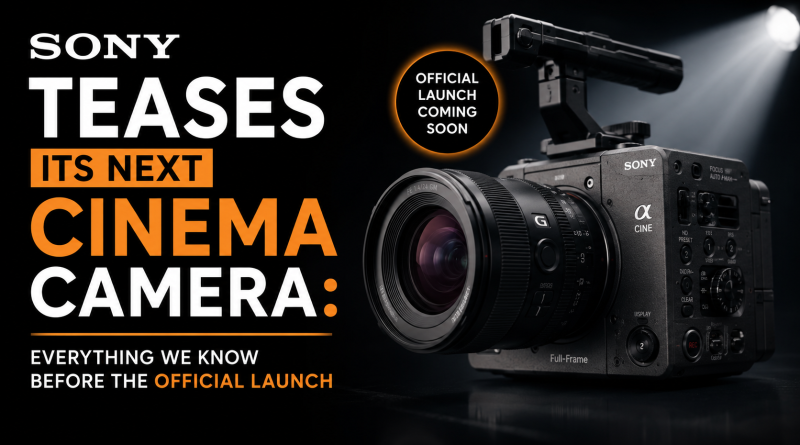
Sony Teases Its Next Cinema Camera: Everything We Know Before the Official Launch
The professional filmmaking industry rarely stands still, and neither does Sony. Over the past decade, the company has built a strong reputation for producing cameras that balance cutting-edge technology with practical usability. Whether it’s independent filmmakers, documentary creators, commercial production teams, or digital content creators, Sony’s Cinema Line has become a trusted choice for professionals who demand exceptional image quality and reliable performance.
Now, Sony has once again captured the attention of the creative world by teasing its next Cinema Line camera. Although the company has not officially revealed the product’s name or complete specifications, the announcement has already generated widespread discussion across photography and filmmaking communities. Industry analysts, professional videographers, and technology enthusiasts are carefully examining every detail of Sony’s teaser, hoping to understand what innovations the company is preparing to introduce.
The anticipation surrounding this launch is more than simple curiosity. Every major Cinema Line release has historically introduced features that eventually become industry standards. As production requirements continue to evolve, creators are looking for equipment that delivers outstanding image quality while simplifying complex workflows. Sony appears ready to continue that tradition.
Sony’s Growing Influence in Professional Filmmaking
Sony‘s position in the professional camera market has strengthened significantly over the last several years. While the company has long been respected for its mirrorless Alpha series, its Cinema Line has opened new opportunities for filmmakers seeking compact cameras without sacrificing professional capabilities.
Models such as the FX3, FX6, FX9, and the flagship VENICE series have found their way onto film sets, television productions, documentaries, corporate videos, weddings, and commercial advertising campaigns. This broad adoption reflects Sony’s ability to develop equipment that serves both large production companies and independent creators.
One reason for this success is Sony’s focus on practical innovation rather than simply increasing technical specifications. Features like advanced autofocus, impressive low-light performance, high dynamic range, and efficient recording formats have made Sony cameras attractive to professionals working under demanding conditions.
With another Cinema Line announcement approaching, expectations are naturally high.
Why This Launch Matters
Every new professional camera launch represents more than upgraded hardware. It influences purchasing decisions, rental markets, production planning, and even educational institutions that teach filmmaking.
Production companies often invest thousands of dollars in camera systems that remain part of their workflow for many years. Choosing a new camera requires careful consideration of image quality, lens compatibility, recording formats, post-production efficiency, durability, and long-term manufacturer support.
Sony understands these expectations. Rather than introducing products purely for marketing purposes, the company has consistently focused on solving real challenges faced by filmmakers.
If early industry speculation proves accurate, the upcoming Cinema Line model could offer meaningful improvements instead of incremental upgrades.
A Carefully Planned Teaser Campaign
Sony’s teaser campaign has been intentionally minimalistic. Instead of revealing detailed specifications, the company has relied on cinematic visuals and carefully selected messaging that emphasizes innovation and creative possibilities.
This strategy is common among major camera manufacturers. By revealing only limited information before launch, companies encourage discussion across professional communities while maintaining excitement leading up to the official announcement.
The teaser’s visual style suggests that Sony continues to prioritize cinematic storytelling rather than purely technical achievements. This aligns with the company’s long-standing approach of developing cameras that serve both artistic expression and commercial production requirements.
While official specifications remain confidential, the teaser itself indicates that Sony views this release as an important addition to its Cinema Line ecosystem.
Rumors Continue to Build Excitement
As with every major camera announcement, unofficial reports have begun circulating within the industry. Although none of these details have been confirmed by Sony, several respected sources have suggested possible improvements that could appear in the new model.
Among the most discussed rumors is the possibility of a newly developed full-frame stacked sensor combined with Sony’s next-generation image processing technology. Such a combination could improve image quality while increasing overall camera responsiveness.
Many industry observers also expect Sony to continue expanding its artificial intelligence capabilities. Recent camera models have demonstrated remarkable autofocus performance, capable of recognizing people, animals, vehicles, birds, and various moving subjects. Future improvements may further enhance focus accuracy during complex shooting situations.
Another widely discussed possibility is enhanced recording flexibility through Open Gate capture, giving filmmakers additional creative freedom during post-production.
Although these features remain speculative until Sony’s official presentation, they illustrate the industry’s expectations regarding modern cinema cameras.
Responding to the Changing Needs of Creators
The filmmaking landscape has changed dramatically in recent years. Today’s professionals rarely create content for a single platform. Instead, one production may be distributed across television, streaming services, YouTube, Instagram, TikTok, LinkedIn, and corporate websites.
This shift has created demand for cameras that can efficiently produce high-quality footage suitable for multiple aspect ratios and delivery formats.
Modern creators also work under tighter deadlines than ever before. Faster autofocus, improved stabilization, efficient codecs, and simplified post-production workflows are no longer considered luxury features—they have become essential production tools.
Sony has consistently adapted to these evolving requirements, making it reasonable to expect that its newest Cinema Line camera will continue supporting hybrid production environments where flexibility is just as valuable as image quality.
More Than Hardware
Professional filmmaking has never been solely about cameras. Lighting, lenses, audio equipment, editing software, and creative vision all play equally important roles. However, the camera remains the foundation of every production, influencing everything from visual style to editing efficiency.
Sony’s continued investment in cinema technology demonstrates its understanding that creators need dependable tools capable of performing consistently under real production conditions.
Rather than focusing exclusively on headline specifications, professionals often evaluate cameras based on reliability, usability, workflow compatibility, and long-term value. Sony has traditionally performed well in these areas, which explains why anticipation surrounding this latest teaser continues to grow.
Sony Teases Its Next Cinema Camera
As excitement builds around Sony’s upcoming Cinema Line announcement, the conversation has shifted from speculation to practical expectations. Professional filmmakers are not simply asking what new features the camera might include—they want to know how those improvements could affect their daily workflow. In today’s competitive creative industry, even small advancements in speed, reliability, and image quality can make a noticeable difference on set.
While Sony has yet to officially confirm the camera’s specifications, the company’s track record suggests that this launch will focus on solving real production challenges rather than simply adding impressive numbers to a specification sheet.
Image Quality Remains the Highest Priority
Regardless of how camera technology evolves, image quality continues to be the deciding factor for professionals. Filmmakers expect footage that delivers accurate colors, natural skin tones, excellent dynamic range, and clean performance across a variety of lighting conditions.
Sony has consistently invested in sensor technology that balances resolution with sensitivity. Instead of chasing extremely high megapixel counts, many cinema cameras prioritize larger pixels that capture more light, helping reduce image noise and preserve detail in difficult environments.
If the rumored full-frame sensor becomes reality, creators can expect improved low-light performance along with the cinematic depth of field that has become a hallmark of modern filmmaking. This combination is particularly valuable for documentaries, weddings, interviews, travel productions, and narrative filmmaking, where lighting conditions often change without warning.
Artificial Intelligence Is Changing Camera Technology
Artificial intelligence has quickly become one of the most significant developments in modern camera systems. What was once limited to simple face detection has evolved into advanced subject recognition capable of tracking people, animals, vehicles, and fast-moving objects with remarkable accuracy.
Sony has been one of the industry’s leaders in this area, integrating dedicated AI processing into several recent camera models. These systems help maintain focus even when subjects temporarily leave the frame, turn away from the camera, or move unpredictably.
For filmmakers working without a dedicated focus puller, these advancements can dramatically improve production efficiency. Solo creators, small production teams, and event videographers especially benefit from dependable autofocus that allows them to concentrate on storytelling rather than constantly adjusting focus manually.
Future improvements could include smarter scene recognition, faster subject tracking, and smoother focus transitions, making professional-quality results easier to achieve.
Workflow Matters More Than Ever
Capturing beautiful footage is only one part of a successful production. Editing, color grading, file management, and content delivery are equally important.
Modern productions frequently create content for multiple platforms simultaneously. A single commercial project may require horizontal videos for television, vertical content for social media, short promotional clips, behind-the-scenes footage, and high-resolution still frames.
Features such as Open Gate recording, efficient codecs, faster memory card support, and improved connectivity can significantly reduce editing time while giving creators greater flexibility during post-production.
Sony has traditionally designed its professional cameras with workflow efficiency in mind, making them attractive not only to filmmakers but also to advertising agencies, marketing teams, corporate communication departments, and digital content creators.
Competition Is Driving Innovation
Sony is entering a highly competitive professional camera market.
Manufacturers including Canon, Nikon, Panasonic, Fujifilm, Blackmagic Design, and RED continue introducing capable cinema cameras aimed at both independent creators and large production companies. Each brand has its own strengths, whether it’s color science, recording formats, autofocus performance, modular design, or affordability.
This competition benefits creators because it encourages continuous innovation. Companies are no longer competing solely on sensor resolution. Instead, they focus on practical improvements such as faster processing, improved stabilization, better battery performance, enhanced cooling systems, and smarter software features.
Sony’s upcoming Cinema Line release appears positioned to reinforce its reputation for combining compact design with professional-level performance.
Who Should Consider This Camera?
Although Sony has not officially announced its intended audience, the upcoming model is expected to appeal to a broad range of professionals.
Independent filmmakers seeking cinema-quality footage without investing in extremely large production systems may find it attractive. Wedding videographers often value compact cameras that perform reliably during long shooting days. Documentary filmmakers appreciate lightweight equipment capable of adapting to changing environments, while commercial production companies look for dependable systems that integrate smoothly into existing workflows.
Content creators working across YouTube, streaming platforms, online education, and social media may also benefit from improved autofocus, flexible recording formats, and efficient post-production workflows.
Rather than targeting a single market segment, Sony’s Cinema Line has traditionally served creators who require professional performance in a portable form factor.
Is It Worth Waiting?
Whenever a major camera launch approaches, buyers face an important question: purchase current equipment or wait for the newest release?
For professionals whose current camera meets production requirements, waiting for Sony’s official announcement is a sensible approach. The final specifications, pricing, recording capabilities, and availability will ultimately determine whether upgrading is worthwhile.
On the other hand, creators using older camera systems may find that recent technological advancements—including improved autofocus, enhanced dynamic range, better low-light performance, and AI-assisted shooting—justify moving to a newer platform.
The decision should always be based on creative needs rather than marketing excitement. A camera is an investment in a production workflow, and the best choice is one that supports long-term goals.
Looking Ahead
The professional filmmaking industry continues to evolve at an extraordinary pace. Higher-quality streaming platforms, virtual production, artificial intelligence, cloud collaboration, and growing demand for premium video content are reshaping how creators work.
Sony has consistently adapted to these changes by developing cameras that balance innovation with practical usability. While official details remain under wraps until the launch event, the company’s teaser has already achieved its purpose—it has sparked meaningful conversations throughout the filmmaking community.
Whether the upcoming Cinema Line camera introduces revolutionary features or carefully refined improvements, it represents another step forward in Sony’s commitment to professional creators.
The official announcement will provide the complete picture, but one thing is already clear: the future of digital cinematography continues to evolve, and Sony intends to remain an important part of that journey.
Create Exceptional Visual Stories with ColourCubz
A professional camera is only the beginning of creating impactful visual content. The real difference comes from creativity, planning, technical expertise, and the ability to transform ideas into compelling stories.
At ColourCubz, we specialize in delivering high-quality photography, videography, and creative digital solutions that help businesses, brands, and individuals stand out in today’s competitive marketplace. Whether you’re launching a product, organizing a corporate event, promoting your services, or building your brand online, our experienced creative team is dedicated to producing visuals that leave a lasting impression.
Our services include:
- Professional Photography
- Commercial & Product Photography
- Corporate Photography
- Event Photography & Videography
- Cinematic Brand Films
- Drone Photography & Videography
- Social Media Content Creation
- Creative Design & Branding
- Digital Marketing Solutions
Every project we undertake is guided by creativity, precision, and a commitment to delivering exceptional quality. We believe that every photograph and every video should tell a meaningful story that connects with your audience.
To explore our portfolio or discuss your next creative project, visit https://www.colourcubz.com/ and discover how ColourCubz can help bring your vision to life.